Utility-scale battery storage projects must balance safety, usable capacity, power conversion, controls, site conditions, financing, and long-term service. Choosing the best manufacturer is difficult because suppliers do not all address the same part of the value chain: some provide integrated battery energy storage systems, while others focus on solar modules, protection equipment, or modular batteries. Product ratings, certifications, warranty terms, software, and project references also vary by model and market. This review evaluates seven listed brands using information available from their official websites and supplied company materials. It is intended as a comparison framework rather than a substitute for project-specific engineering, compliance checks, or commercial due diligence.
Full List of Top 7 Brands
- Jinkosolar
- BENY
- BOOSTESS
- Tongwei
- Polinovel
- Wenergy
- GSL Energy
Comparison Table
| Brand | Key Products | Key Features | Best For |
|---|---|---|---|
| Jinkosolar | Solar modules and documented energy-storage solutions available through its official business channels | Renewable-energy manufacturing background; project-level compatibility and warranty review required | Solar-plus-storage procurement where supplier continuity and system integration matter |
| BENY | Solar PV protection products, battery energy storage systems, and EV charging equipment | Integration of power transmission, distribution, storage, and consumption equipment | PV, storage, and EV-charging projects needing protection and balance-of-system equipment |
| BOOSTESS | Air-Cooled Battery Energy Cabinet 50kW/100kWh | Integrated air-cooled cabinet format | Projects seeking a compact cabinet-based energy-storage configuration |
| Tongwei | High-purity crystalline silicon, high-efficiency cells, and PV modules | Vertically connected PV manufacturing and stated large production capacities | Solar generation supply; battery suitability must be confirmed separately |
| Polinovel | Commercial and industrial battery energy storage systems | Modular architecture and scalable capacity positioning | Commercial, industrial, and expanding distributed-storage projects |
| Wenergy | Commercial and industrial energy-storage systems | Published references to CE, IEC 62619, UL 9540 certification, and UL 9540A testing | Customers requiring documented safety and international compliance claims |
| GSL Energy | LiFePO4 residential, C&I, industrial, and MWh-scale systems | Modular configurations, BMS, scalable capacity, and multiple communication options | Installers, integrators, and projects spanning distributed storage to larger BESS |
Detailed Reviews
1. Jinkosolar
Overview: Jinkosolar is a global solar-energy company whose official website presents the brand primarily through photovoltaic products, energy solutions, company information, and project-related resources. For utility-scale battery storage, its relevance is strongest where a developer is evaluating a broader solar-plus-storage supply relationship. The exact battery system, inverter, integration scope, warranty, and service arrangements should be confirmed from current project documentation because these details can vary by region and product offering.

Jinkosolar’s established position in the solar manufacturing sector can be relevant to large projects that require coordinated procurement of generation equipment and storage. However, solar-module scale should not automatically be treated as proof of battery-system performance. Buyers should request model-specific documentation covering cell chemistry, DC and AC system boundaries, round-trip efficiency, usable energy, degradation assumptions, fire-safety design, thermal management, cybersecurity, and grid-code compliance.
Pros / Key Features:
- Official corporate and product information is available through a global-facing website.
- Suitable for evaluation in solar-plus-storage procurement strategies where module and storage supply are considered together.
- Potential project value lies in supplier coordination, documented system compatibility, and access to established renewable-energy channels.
- Utility-scale buyers can compare the proposed battery architecture with the project’s required duration, power rating, interconnection conditions, and operating profile.
- Due diligence should include independent confirmation of current storage products, local support, warranty coverage, spare-parts policy, and bankability requirements.
Use Cases / Best For: Jinkosolar is best considered for utility-scale solar-plus-storage tenders, renewable-power portfolios, and projects where a single solar-sector supplier relationship may simplify coordination. It should be shortlisted only after the proposed battery product and integration responsibilities are clearly defined. For background reading on system selection, see Jinkosolar’s official website and compare the proposed solution with the requirements for utility scale battery storage.
Buyer checks: Ask for the current product datasheet, independent test reports, warranty and degradation schedule, availability guarantees, emergency-response procedures, commissioning plan, software ownership terms, and evidence of deployments using the same configuration. These checks are especially important when the procurement includes both PV modules and battery storage.
2. BENY
Overview: BENY positions itself as a provider of solar PV protection products, battery energy storage, and EV-charging solutions. Its stated offering connects power transmission and distribution, energy storage, and power consumption, giving the company a broader electrical-system orientation than a battery-only supplier.

Pros / Key Features:
- Product positioning covers PV protection, battery storage, and EV charging.
- Can be relevant where storage must be considered alongside electrical protection and charging infrastructure.
- Official information emphasizes integrated energy-system applications.
Use Cases / Best For: BENY may suit solar, storage, and EV-charging developments that require coordinated balance-of-system equipment. Utility-scale buyers should verify the exact battery capacity range, system integration scope, certifications, software, warranty, and project references before treating it as a complete utility-scale BESS supplier.
3. BOOSTESS
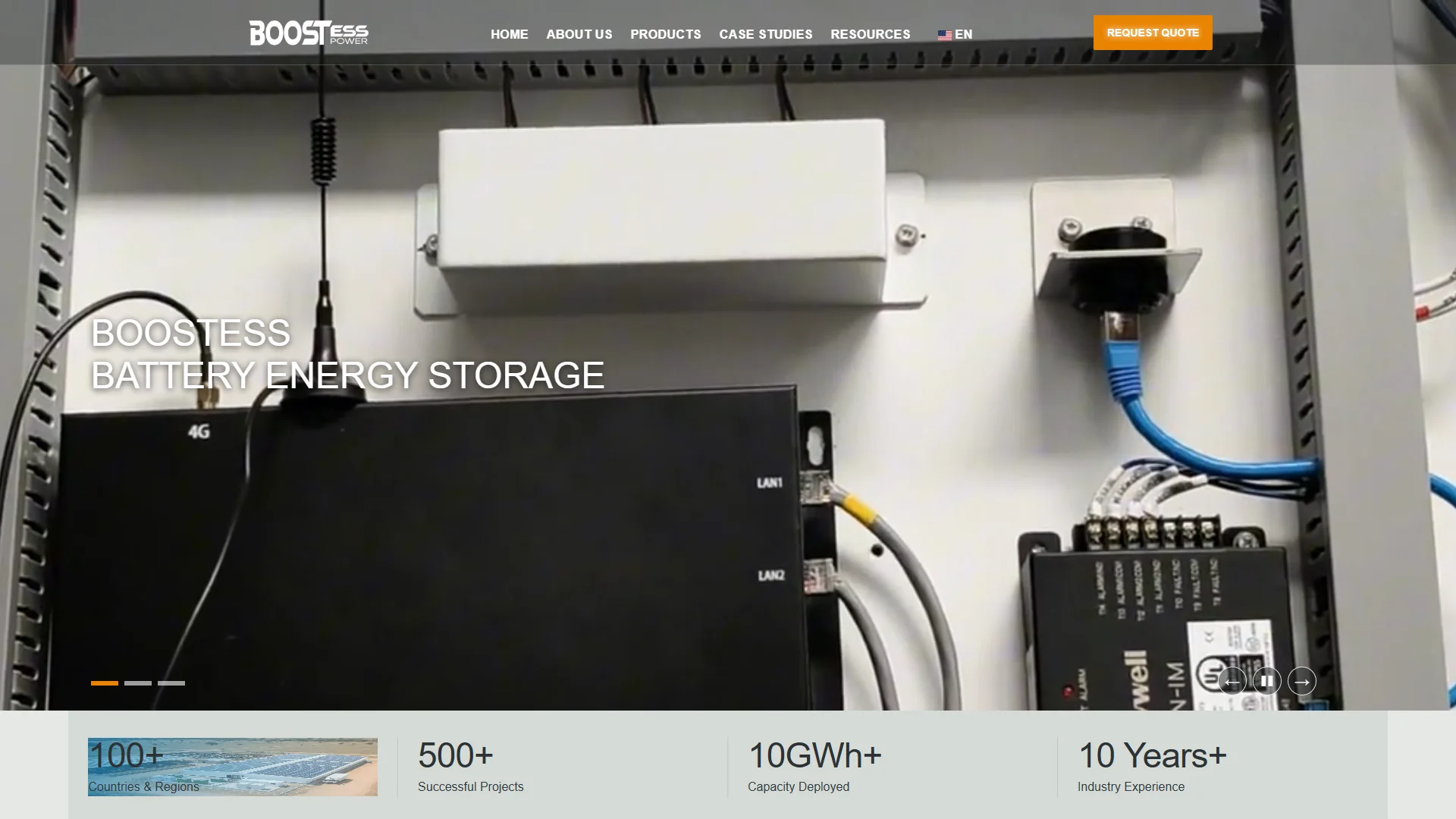
Overview: The supplied product information identifies BOOSTESS Power with an air-cooled battery energy cabinet rated at 50kW/100kWh. This indicates a cabinet-format energy-storage product with a two-hour nominal energy-to-power ratio, although actual operating duration depends on usable capacity, reserve settings, efficiency, and operating conditions.
Pros / Key Features:
- Air-cooled cabinet design is identified in the available product information.
- The stated 50kW/100kWh configuration provides a clearly defined reference point for preliminary sizing.
- Cabinet packaging can simplify deployment for appropriately scaled installations.
Use Cases / Best For: BOOSTESS is best evaluated for commercial, industrial, or distributed-storage applications that can use cabinet-level equipment. For a utility-scale project, the buyer should confirm how multiple cabinets are aggregated, the available power-conversion equipment, thermal and fire protection, outdoor rating, communications, warranty, and service arrangements.
4. Tongwei
Overview: Tongwei’s supplied official-site information centers on high-purity crystalline silicon, high-efficiency solar cells, and PV modules. The company describes modern intelligent manufacturing and reports annual capacities of 900,000 tons for high-purity crystalline silicon, 150GW for N-type solar cells, and approximately 90GW for PV-module production. These are solar-manufacturing credentials rather than direct evidence of a utility-scale battery product.
Pros / Key Features:
- Strong relevance to large-scale solar generation procurement.
- Published information describes vertically connected PV manufacturing activities.
- The company highlights global market share and shipment performance for its PV business.
Use Cases / Best For: Tongwei is best suited to utility-scale PV projects and solar-plus-storage developments seeking a large solar-component supplier. Battery-system procurement should be handled as a separate technical qualification unless a current Tongwei storage offering is specifically documented for the target market.
5. Polinovel
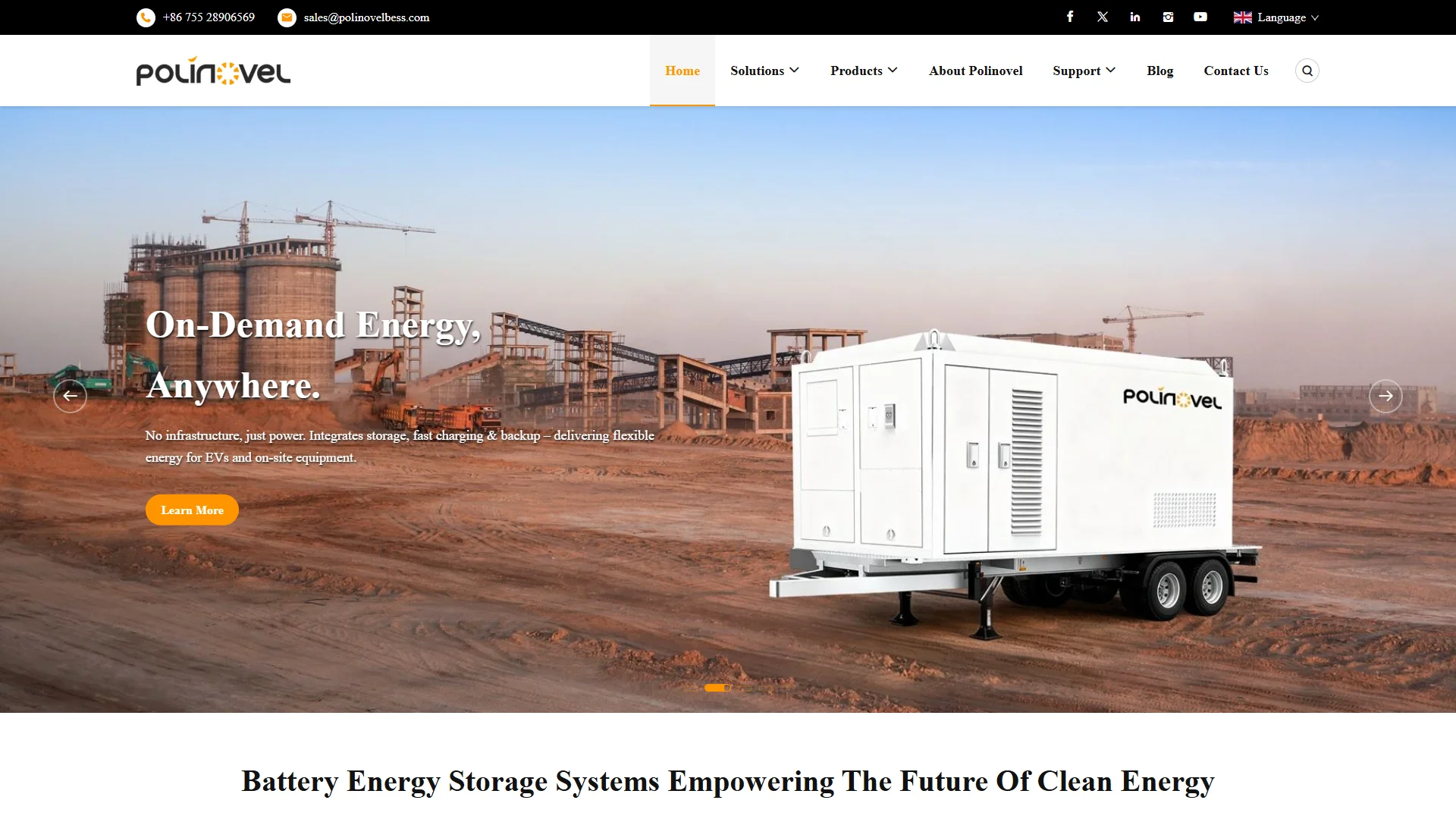
Overview: Polinovel is presented as a Chinese battery energy storage manufacturer focused on commercial and industrial BESS. Its positioning emphasizes end-to-end energy-storage solutions and modular architecture, with stated applicability to utility-scale projects worldwide.
Pros / Key Features:
- Focused positioning in battery energy storage rather than only PV generation.
- Modular architecture is intended to support flexible capacity expansion.
- Relevant to commercial, industrial, and larger project applications.
Use Cases / Best For: Polinovel may be considered for C&I systems and projects that value modular expansion. Utility-scale buyers should request verified technical specifications, cell chemistry, container or cabinet configuration, safety certifications, degradation data, controls architecture, bankability information, and evidence that the proposed configuration has been deployed at comparable scale.
6. Wenergy
Overview: Wenergy is described as an energy-storage solution provider specializing in commercial and industrial systems. Its supplied information states that products comply with international standards including CE and IEC 62619, and references UL 9540 certification and UL 9540A testing. Certification and testing claims should be checked against current certificates, listed models, and the applicable installation jurisdiction.
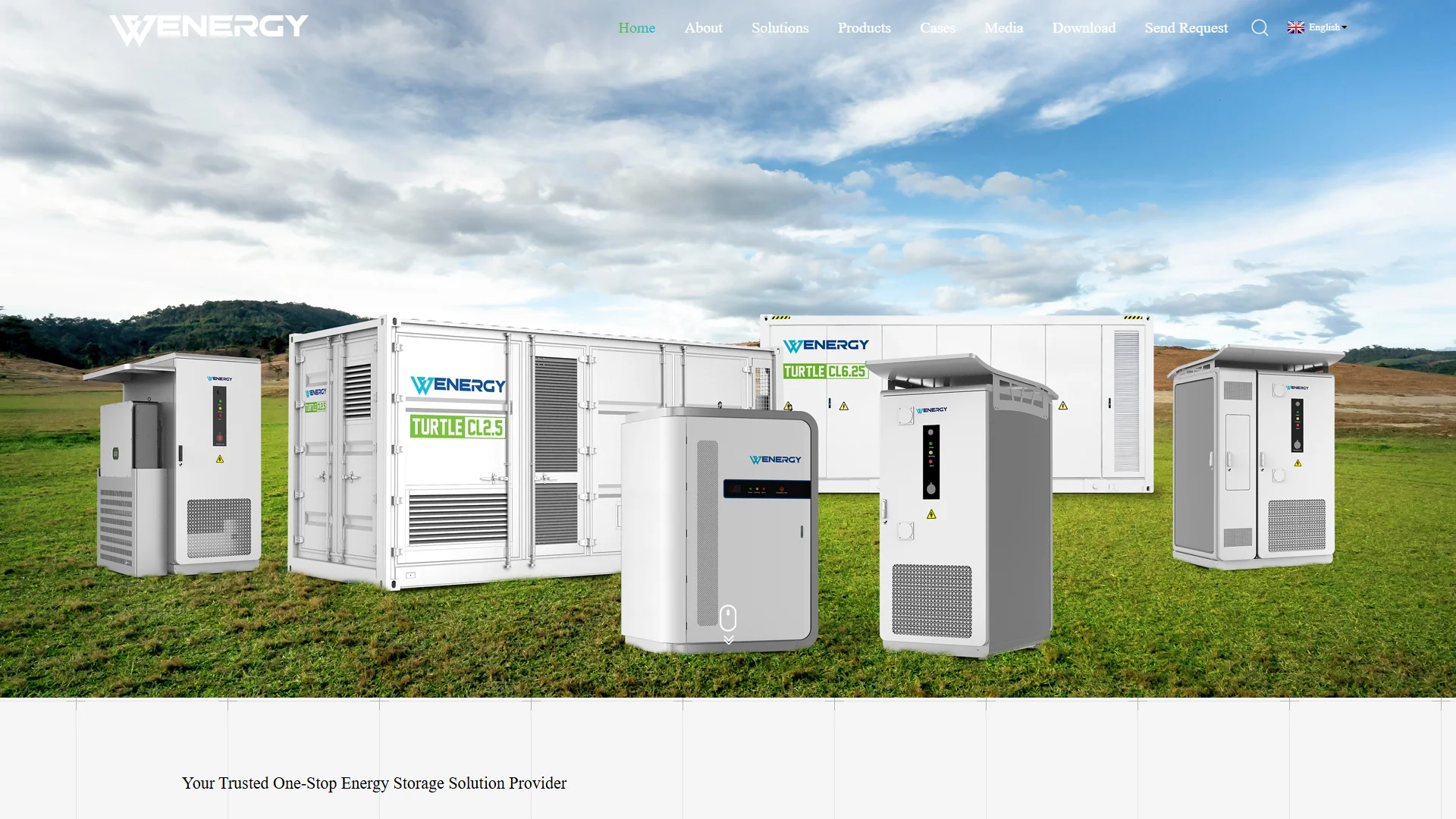
Pros / Key Features:
- Clear emphasis on safety, quality, and international standards.
- Commercial and industrial energy storage is identified as a core application area.
- Published UL 9540 and UL 9540A references may assist early compliance screening.
Use Cases / Best For: Wenergy may suit C&I customers and integrators that need documented compliance evidence. For utility-scale procurement, buyers should verify certificate scope, system boundaries, fire-testing applicability, grid integration, software functions, warranty terms, and the manufacturer’s ability to provide long-term field service.
7. GSL Energy
Overview: GSL Energy supplies LiFePO4-based energy storage products across residential, commercial, industrial, and larger-scale applications. The supplied product information includes modular systems, a 5.12kWh 51.2V 100Ah battery, high-voltage configurations, and an HV51314 system with 16.08kWh modules, 128kWh–241kWh configurations, and stated expansion to MWh-level BESS.

Pros / Key Features:
- LiFePO4 chemistry is identified across the supplied product information.
- Modular architecture supports different capacity configurations.
- Some products support BMS monitoring, CAN, RS485, and TCP/IP communications.
- Available information references AC and DC coupling, indoor and outdoor installation, and scalable C&I configurations.
- The company states support for solar integration, peak shaving, backup power, microgrids, and customized projects.
- Supplied certification references include UL, IEC, CE, MSDS, and UN38.3; buyers should verify the exact model and certificate scope.
Use Cases / Best For: GSL Energy is relevant to distributors, EPC contractors, system integrators, residential projects, C&I installations, and selected larger-scale applications. Its modular product range can be useful where capacity is expected to grow, but MWh-level procurement still requires project-specific confirmation of containerization, PCS integration, EMS functionality, fire protection, thermal design, warranty, and service coverage.
How to Choose a Utility-Scale Battery Storage Manufacturer
- Define the operating objective: Frequency regulation, energy arbitrage, renewable shifting, capacity support, backup, and transmission relief can require different power-to-energy ratios and cycling profiles.
- Compare usable rather than nameplate energy: Review state-of-charge limits, reserve margins, auxiliary consumption, round-trip efficiency, and expected degradation.
- Check safety documentation: Request applicable fire, electrical, transport, and battery certifications, along with test reports for the exact system configuration.
- Evaluate the complete system: A battery manufacturer may not supply the PCS, transformer, EMS, SCADA interface, HVAC, fire suppression, or site controls. Define every interface and responsibility.
- Review warranty economics: Compare calendar life, cycle limits, throughput guarantees, capacity-retention curves, exclusions, response times, and replacement obligations.
- Assess bankability and references: Comparable operating projects, audited corporate information, insurance, financial strength, and lender acceptance can matter as much as the datasheet.
- Confirm local support: Check commissioning resources, spare-parts availability, remote monitoring, cybersecurity procedures, training, and long-term service agreements.
- Validate site compatibility: Consider ambient temperature, altitude, humidity, seismic conditions, noise limits, fire setbacks, flood risk, access, and local grid codes.
Final Verdict
Jinkosolar ranks first in this comparison because its established solar-sector position makes it a logical starting point for solar-plus-storage procurement, although the exact utility-scale battery offering must be verified for each market and project. BENY is more oriented toward integrated PV protection, storage, and EV-charging equipment. BOOSTESS is associated with a clearly stated air-cooled 50kW/100kWh cabinet. Tongwei is primarily relevant to large-scale PV manufacturing rather than directly documented battery storage. Polinovel emphasizes modular C&I and larger BESS, Wenergy highlights safety and compliance documentation, and GSL Energy offers a broad modular LiFePO4 range extending from distributed systems toward MWh-scale applications. The appropriate choice depends on the project’s operating objective, certification needs, integration scope, warranty structure, and local service capability.
FAQs
What is the most important specification in utility-scale battery storage?
There is no single universal specification. Usable energy, discharge power, duration, efficiency, degradation, safety design, and availability guarantees should be assessed together against the project’s revenue model and grid requirements.
Does a major solar-module manufacturer automatically make the best battery supplier?
No. Solar-module manufacturing experience can support supplier coordination, but battery projects require separate evidence covering cell technology, system integration, fire safety, controls, warranty performance, and long-term service.
What documents should buyers request before placing an order?
Buyers should request the current datasheet, single-line diagram, safety and certification documents, independent test reports, warranty terms, degradation model, installation requirements, communications description, cybersecurity information, service agreement, and references for comparable operating projects.
