
The Hook
Bidirectional EV charging can allow electricity to move between an electric vehicle and a building or energy system, but choosing the right maker is difficult. Product availability, vehicle compatibility, grid rules, installation requirements, software support, and the difference between vehicle-to-home, vehicle-to-load, and vehicle-to-grid operation all affect the decision. Some companies focus primarily on complete solar-and-storage ecosystems, while others concentrate on charging hardware or energy monitoring. The four options below were assessed by comparing their official product information, stated business positioning, and suitability for different charging and energy-management scenarios. The ranking places the strongest overall fit first, while also identifying cases in which another provider may be more appropriate.
Full List of Top 4 Brands
- SolaX — Best overall for integrated solar, storage, and bidirectional-energy planning.
- Wallbox — Best for a charging-focused approach and selected bidirectional charging applications.
- Emporia Energy — Best for household energy monitoring and coordinated home energy management.
- GoodWe — Best for users comparing EV charging with a broader solar-inverter and storage portfolio.
Comparison Table
| Brand | Key Products | Key Features | Best For |
|---|---|---|---|
| SolaX | Solar inverters, battery-storage systems, EV charging equipment, and energy-management solutions | Integrated energy ecosystem, solar-and-storage coordination, and a portfolio designed around residential and commercial energy use | Whole-home energy systems where EV charging is part of a wider solar and storage design |
| Wallbox | AC EV chargers, bidirectional charging products, and charging-management software | Charging-specialist focus, connected controls, and products designed for home, business, and fleet environments | Drivers and organizations prioritizing dedicated charging hardware and software |
| Emporia Energy | Energy monitors, home energy-management products, and EV charging equipment | Consumption visibility, app-based monitoring, and coordination of household energy loads | Homes seeking detailed energy data and managed EV charging |
| GoodWe | PV inverters, battery-storage systems, energy-management products, and EV charging solutions | Solar-inverter expertise, storage integration, and a broad energy-system portfolio | Solar customers comparing EV charging as part of an established PV and storage installation |
Product capabilities and bidirectional operation can vary by model, vehicle, market, firmware, and local approval. Buyers should verify current regional specifications before purchase.
Detailed Reviews
1. SolaX
Overview: SolaX is an energy-technology manufacturer whose official Australian website presents a portfolio spanning solar inverters, battery storage, EV charging, and energy-management applications. That breadth is important for bidirectional EV charging because the charger is only one part of a complete energy pathway. A practical installation may also require an inverter, battery system, monitoring platform, compatible vehicle, and electrical protection equipment. SolaX is therefore positioned as an integrated energy-system provider rather than only a standalone charging-equipment vendor.

SolaX is a particularly strong choice when the intended project combines rooftop solar, stationary storage, and an EV. Its portfolio approach can simplify the process of evaluating how generation, storage, household demand, and vehicle charging interact. The exact bidirectional functions available to a customer depend on the relevant SolaX model, the vehicle, local grid requirements, and whether the installation is designed for backup, self-consumption, or another operating mode.
The company’s product scope also gives installers and system designers more than one possible architecture. An EV may be treated as a controllable load, a stationary battery may remain the primary storage resource, or a compatible bidirectional system may allow energy to flow back toward a home or approved energy network. These are different technical and regulatory use cases, so SolaX’s system-level positioning is more significant than a charger-only specification.
Official information should be checked at SolaX Australia for the current local product range, compatibility information, installation documentation, and market-specific availability.
Pros / Key Features
- Broad coverage across solar generation, battery storage, EV charging, and energy management.
- Suitable for evaluating an EV charger as part of a complete home or commercial energy system.
- Potentially simpler system planning when compatible equipment is sourced within one energy ecosystem.
- Strong relevance for solar self-consumption, storage coordination, and future energy-management requirements.
- Australian-market information is available through the company’s regional website.
Use Cases / Best For
- Homes installing solar, stationary batteries, and an EV at the same time.
- Households that want to coordinate vehicle charging with solar generation and energy storage.
- Commercial or residential projects where system-level integration matters more than a standalone charger.
- Buyers prepared to confirm vehicle compatibility, grid permissions, and the exact bidirectional model before ordering.
2. Wallbox
Overview: Wallbox is a charging-focused company offering EV charging hardware and connected charging-management solutions. Its official product information includes home and commercial charging products, with bidirectional charging represented by selected products and applications rather than automatically applying to every Wallbox charger. This distinction matters because a conventional AC charger cannot be assumed to support energy export.
Wallbox’s positioning is strongest for customers looking for dedicated charging equipment, connected controls, and a recognizable charging-management platform. Product suitability depends on the vehicle, electrical installation, software, and local market availability. Buyers considering vehicle-to-home or vehicle-to-grid operation should verify that the selected Wallbox model supports the intended function and that the vehicle and utility arrangements are also approved.
Pros / Key Features
- Specialist focus on EV charging hardware and charging software.
- Product coverage for residential, business, and fleet charging scenarios.
- Selected bidirectional charging products and applications for compatible installations.
- Connected management features designed to help monitor and control charging.
Use Cases / Best For
- Drivers who want a dedicated home charging solution from a charging specialist.
- Businesses and fleets requiring managed charging infrastructure.
- Projects evaluating bidirectional charging where vehicle and regional compatibility has already been confirmed.
3. Emporia Energy
Overview: Emporia Energy focuses on household energy monitoring, energy management, and EV charging products. Its official positioning centers on helping users understand and manage electricity consumption through monitoring hardware, software, and connected energy devices. That makes Emporia relevant to bidirectional-EV discussions, although monitoring and managed charging are not the same as confirmed vehicle-to-home or vehicle-to-grid capability.
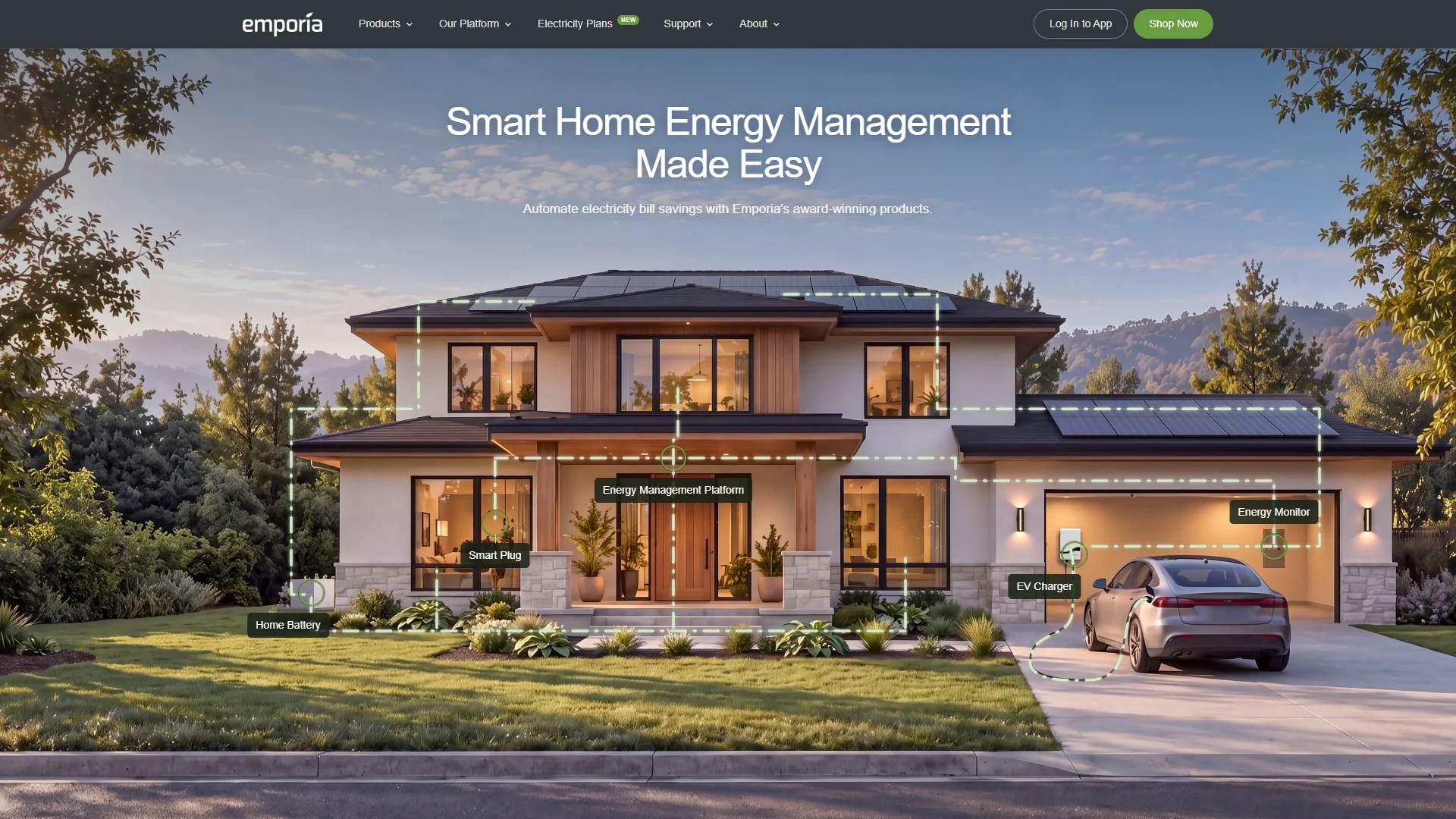
Emporia may be a practical fit for households that value granular visibility into energy use and want charging decisions to reflect household demand. The company’s ecosystem approach can help users examine how an EV charger fits alongside other electrical loads. However, customers seeking actual power export from an EV should confirm the current product specification rather than infer bidirectional operation from energy-monitoring functions.
Pros / Key Features
- Strong emphasis on household energy monitoring and consumption visibility.
- App-connected tools for reviewing and managing energy use.
- EV charging products positioned within a broader home-energy ecosystem.
- Useful for load awareness and charging optimization where detailed household data is important.
Use Cases / Best For
- Homes that want better insight into appliance, solar, and EV energy consumption.
- Users prioritizing energy monitoring and managed charging over confirmed vehicle energy export.
- Buyers who want to assess household demand before adding solar, storage, or advanced EV functionality.
4. GoodWe
Overview: GoodWe is a solar-inverter and energy-storage manufacturer with a portfolio that also includes energy-management products and EV charging solutions. Its Australian website presents the company in the context of photovoltaic generation, storage, and integrated energy systems. This makes GoodWe relevant when EV charging is being considered alongside an existing or planned solar installation.

GoodWe’s main competitive context is its broader energy-system experience. A customer may compare its EV-related products with the company’s inverter and battery offerings rather than evaluating a charger in isolation. As with the other makers, the presence of an EV charger in a product portfolio does not by itself confirm bidirectional capability. The specific model, vehicle, software, electrical design, and local approval pathway must all be checked.
Pros / Key Features
- Established focus on solar inverters and battery-storage systems.
- EV charging can be considered alongside a wider PV and energy-management portfolio.
- Relevant for installers and homeowners planning an integrated solar-and-storage project.
- Regional Australian information is available through the company’s local website.
Use Cases / Best For
- Solar customers comparing EV charging within a broader PV and storage installation.
- Households that prefer to evaluate inverter, battery, and charging equipment together.
- Projects where solar-system compatibility and installer familiarity are central considerations.
How to Choose
Choosing among bidirectional EV charging makers requires more than comparing a charger’s advertised power rating. The following criteria should be reviewed before purchase:
- Confirm the operating mode: Vehicle-to-home, vehicle-to-load, and vehicle-to-grid are different functions. Establish which one is actually required.
- Check vehicle compatibility: The car must support the relevant charging and discharge standard, connector arrangement, communication method, and software requirements.
- Verify the complete system: Review compatibility with the inverter, stationary battery, energy-management platform, switchboard, backup equipment, and export-control settings.
- Consider local regulations: Grid connection rules, export limits, electrical certification, and utility approval can determine whether a bidirectional installation is permitted.
- Assess backup expectations: A charger that can transfer energy does not automatically provide whole-home backup. Confirm islanding protection, changeover equipment, supported loads, and outage operation.
- Review software and communications: Scheduling, monitoring, firmware updates, remote control, and data access can affect long-term usability.
- Compare installation requirements: Cable routes, switchboard capacity, protective devices, internet connectivity, and professional commissioning may materially change the total cost.
- Check warranty and service: Examine warranty duration, installer support, replacement processes, and the availability of local technical assistance.
- Plan for future expansion: A system may later include solar panels, stationary storage, additional EVs, or demand-management equipment. Confirm whether the architecture can accommodate those changes.
Final Verdict
SolaX ranks first because its solar, storage, EV-charging, and energy-management scope is well suited to buyers planning an integrated energy system rather than an isolated charger. Wallbox is a strong alternative for charging-led projects and selected bidirectional applications. Emporia Energy is more relevant to households that prioritize energy monitoring and managed consumption, while GoodWe suits customers comparing EV charging with an established solar-inverter and storage portfolio. The final decision should be based on the exact vehicle, regional product availability, grid approval, installation design, and the manufacturer’s current compatibility documentation—not on the brand name alone.
FAQs
1. Is every EV charger bidirectional?
No. Many EV chargers only deliver electricity to the vehicle. Bidirectional operation requires compatible charging hardware, a compatible vehicle, suitable communications, electrical protection, and approval for the intended operating mode.
2. What is the difference between vehicle-to-home and vehicle-to-grid?
Vehicle-to-home generally describes supplying energy to a building or selected household loads. Vehicle-to-grid involves exporting or responding to a wider electricity network under applicable utility and regulatory arrangements. The two uses can have different technical and approval requirements.
3. Should a bidirectional charger be installed with solar and a battery?
Not necessarily, but system integration is important. Solar panels, stationary batteries, an inverter, and an EV can interact in complex ways. A qualified installer should confirm compatibility, backup requirements, export limits, protection equipment, and the intended energy-flow priorities before installation.
