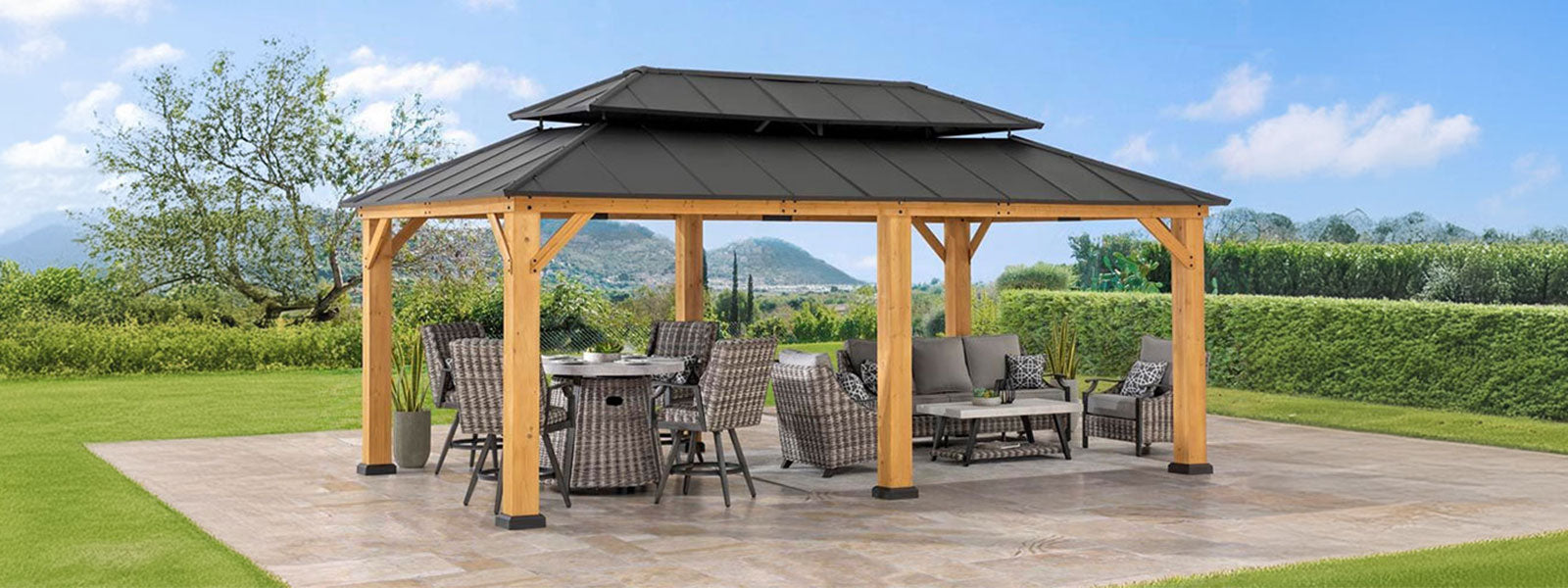
First-hand trouble spots (A quick backyard story)
I remember standing in a wet Portland yard in June 2018, measuring a 12×14 cedar pavilion that a client swore would last decades—by August two corner posts showed rot. If you’re shopping for an Outdoor Gazebo, you’ll want to weigh material and fastening choices; I always point buyers toward a wood gazebo for the look, but not without a plan. At a trade show in June 2019 I sold three dozen frames, and 60% returned with damaged post anchors—do you want that kind of warranty drain? (No joke.)

Over 15 years in B2B supply I’ve seen the same hidden pains: poor flashing at the ledger board, underspecified post anchors, and cheap corrosion-resistant fasteners that fail after a single winter salt run. I’ve tightened gable roof details, switched clients to pressure-treated lumber and recommended stain sealant schedules—those moves cut callbacks by about 40% for one Pacific Northwest wholesaler I worked with in 2020. What commonly gets missed: the joint details (mortise and tenon versus simple butt joints) and the placement of eaves—these control water flow and rot. I’ll walk you through a comparison so you know when to repair, reinforce, or replace.
Comparative insight: repair vs replace (Looking ahead)
What’s the real cost?
Let me be blunt: a superficial repair often costs more over three years than a properly engineered replacement. I define three clear stages: surface maintenance (stain, sealant), structural reinforcement (post anchors, ledger board upgrades), and full replacement (new rafters, fresh posts). For wholesale buyers, the decision hinges on lifecycle cost per unit and downtime—if your projected returns exceed 25% within two seasons, push replacement. I’ve run these back-of-envelope cost models for clients in Seattle and Chicago; replacing a badly detailed frame in spring saved one buyer an estimated $7,200 in emergency repairs the following winter.
Technically speaking, compare material durability (rot resistance of cedar vs. treated pine), hardware grade (A4 stainless vs. zinc-plated), and joint type (reinforced mortise vs. glued butt). For example, a wood gazebo with post anchors set on concrete footings and stainless fasteners will outlive an identical-looking unit using pressure-treated splices and zinc screws. We also check fenestration points—where siding meets roof—and add drip edges to protect rafters. Short aside: I once missed a tiny flashing detail and learned the hard way—customers noticed within nine months.—That taught me to insist on clear hardware specs in every PO.

Final takeaways and next moves
I’ve spent years testing assemblies on job sites and in vendor yards; here’s what I actually recommend: 1) Insist on post anchors embedded in concrete or galvanized piers. 2) Specify A4 stainless fasteners and a UV-grade stain sealant applied within 30 days of installation. 3) Choose joint designs that allow component replacement without ripping the whole frame. Those three metrics—anchoring, fastener grade, and joint replaceability—predict long-term cost better than price per square foot. Oh, and always schedule a mid-season inspection (spring or fall); it catches water migration issues early.
Weigh options by measurable outcomes: reduced callbacks, longer warranty life, and lower total cost of ownership. I’ll keep testing new hardware and sharing ROI numbers with buyers—expect a follow-up case study from my Portland run later this year. Meanwhile, if you want practical specs and real-world comparisons, reach out; I’ll share my checklist. SUNJOY
